Overburden is the material that lies above the area of economic or scientific interest (in mining and archaeology) e.g., the rock, soil and ecosystem that lies above the coal seam or ore body. It is also known as 'waste'. Overburden is distinct from tailings, the material that remains after economically valuable components have been extracted from the generally finely milled ore. Overburden is removed during surface mining, but is typically not contaminated with toxic components and may be used to restore an exhausted mining site to a semblance of its appearance before mining began. Overburden may also be used as a term to describe all soil and ancillary material above the bedrock horizon in a given area.
A related term is interburden, meaning material that lies between two areas of economic interest, such as the material separating coal seams within strata.
By analogy, overburden is also used to describe the soil and other material that lies above a specific geologic feature, such as a buried astrobleme.
From http://en.wikipedia.org/
-
Ear Force X41 (XBOX LIVE Chat + Wireless Digital RF Game Audio with Dolby Headphone 7.1 Surround Sound) - Ear Force X41 (XBOX LIVE Chat + Wireless Digital RF Game Audio with Dolby Headphone 7.1 Surround Sound) by Turtle Beach [image: Ear Force X41 (XBOX LIVE C...
Saturday, May 29, 2010
Overburden
Labels: Mining
Posted by my blog at 7:21 PM 0 comments
Monday, April 26, 2010
Ore sorting
Ore sorting refers to the process of separating an ore into separate constituent parts. Today, ore sorters are widely used in industrial mineral mines, diamond mines and base and precious metal mines.
Ores are typically sorted to increase the efficiency of other refining processes, by reducing the amount of material to be processed while simultaneously increasing its purity.
Modern technologies
Modern, automated sorting applies optical sensors (visible spectrum, near infrared, X-ray, ultraviolet), that can be coupled with electrical conductivity and magnetic susceptibility sensors, to control the mechanical separation of ore into two or more categories.
Commonly sorted ores
* Base and Precious Metals
o Gold
o PGMs
o Copper
o Zinc
o Nickel
* Industrial Minerals
o Pegmatites
o Limestone
o Calcite
o Dolomite
o Coal
o Magnesite
o Quartz
o Feldspar
* Gems
o Diamonds
o Tanzanite
Reasons for industrial sorting
* Pre-concentrate mill feed into high-grade and low-grade fractions
o Build a smaller mill or effectively increase the capacity of an existing mill
o Remove low-grade fraction that is actually costing money to mill
o Add previously uneconomic zones to reserves
o Manage ore blending programs more effectively
* Sort high-grade ore out of low-grade stockpiles and waste dumps
o Recover value from previously uneconomic waste
* Reduce environmental risks and costs
o Reduce mill energy consumption
o Send acid generating waste rock to appropriately designed dumps
* Optimize multiple process streams
o Send appropriate ore directly to the mill, leach heaps or smelter
* Pre-concentrate ore underground or at remote sites
o Reduce haulage and hoisting costs
o Mine satellite orebodies and sort on site
* Monitor the composition of the mill feed
o Provide real time data to operators for process optimization and work index prediction
From http://en.wikipedia.org/
Labels: Mining
Posted by my blog at 7:44 AM 0 comments
Friday, April 23, 2010
Ore concentrate
Ore concentrate text
Ore concentrate, dressed ore or simply concentrate is the product generally produced by metal ore mines. The raw ore is usually ground finely in various comminution operations and tailings(waste) are removed thus concentrating the metal component. The concentrate is then transported to smelters where it is used to produce useful metals.
From http://en.wikipedia.org/
Labels: Mining
Posted by my blog at 6:56 AM 0 comments
Tuesday, April 20, 2010
Optical granulometry
![]()
Optical granulometry is the process of measuring the different grain sizes in a granular material, based on a photograph. Technology has been created to analyze a photograph and create statistics based on what the picture portrays. This information is vital in maintaining machinery in various trades worldwide. Mining companies can use optical granulometry to analyze inactive or moving rock to quantify the size of these fragments. Forestry companies can zero in on wood chip sizes without stopping the production process, and minimize sizing errors.
With more photoanalysis technologies being produced, mining companies have shown an increased interest in these types of systems because of their ability to maintain efficiency throughout the mining process. Companies are saving millions of dollars annually because of this new technology, and are cutting back on maintenance costs on equipment.
In order for optical granulometry to be completely successful, an accurate photo must be taken – under sufficient lighting, and using proper technology – to obtain quantified results. If these requirements are met, an image analysis system can be implemented.
From http://en.wikipedia.org/
Labels: Mining
Posted by my blog at 8:21 PM 0 comments
Friday, April 16, 2010
Oil shale industry
![]()
Oil shale industry is an industry of mining and processing of oil shale—a fine-grained sedimentary rock, containing significant amounts of kerogen (a solid mixture of organic chemical compounds), from which liquid hydrocarbons can be manufactured. The industry has developed in Brazil, China, Estonia and to some extent in Germany, Israel and Russia. Several other countries are currently conducting research on their oil shale reserves and production methods to improve efficiency and recovery. However, Australia has halted their pilot projects due to environmental concerns. Estonia accounts for about 70 % of the world's oil shale production.
Oil shale has been used for industrial purposes since the early 1600s, when it was mined for its minerals. Since the late 1800s, shale oil has also been used for its oil content and as a low grade fuel for power generation. However, barring countries having significant oil shale deposits, its use for power generation is not particularly widespread. Similarly, oil shale is a source for production of synthetic crude oil and it is seen as a solution towards increasing domestic production of oil in countries that are reliant on imports.
From http://en.wikipedia.org/
Labels: Mining
Posted by my blog at 8:27 PM 0 comments
Saturday, April 10, 2010
NAICS 21
NAICS 21 is the category within the North American Industry Classification System which is composed of establishments that extract naturally occurring mineral solids(i.e. as metals, coal and other industrial minerals), liquid minerals (i.e. crude petroleum) and gases (i.e. natural gas).
Definition of mining
NAICS 21 uses the term "mining" to include quarrying, well operations, beneficiating and other mineral preparation customarily performed at the mine sites, or as a part of mining activity and distinguishes two basic activities:
Mine operation
Mine operation includes companies that operate mines, quarries, or oil and gas wells for themselves, and companies which operate them on a contract or fee basis.
Mining support activities
Mining support activities include companies that perform exploration (except geophysical surveying) and other mining services, on a contract or fee basis, with the exception of mine site preparation and construction of oil/gas pipelines.
Further breakdown
Companies are grouped and classified according to the natural resource which is or will be mined. Industries include establishments that develop the mine site, extract the natural resources, and/or those that process the mineral mined.
Smelting and refining
Smelting and refining take place in both the "mineral processing" (NAICS 21) stages and the manufacturing stages (NACIS 31-31).
From http://en.wikipedia.org/
Labels: Mining
Posted by my blog at 12:13 PM 0 comments
Tuesday, April 6, 2010
Mineral industry
Mineral industry is the branch of industry responsible for the exploitation of minerals from soil deposits. This is achieved by mining (through underground excavations or open workings), but also by processing plants. Products of mineral industry include various building materials, such as rocks (ex. granite), but also cement, glass and ceramics.
Worldwide
* Mineral industry of Africa
* Mineral industry of Asia
* Mineral industry of Europe
* Mineral industry of North America
* Mineral industry of South America
o Mineral industry of Colombia
From http://en.wikipedia.org/
Labels: Mining
Posted by my blog at 6:15 PM 0 comments
Sunday, April 4, 2010
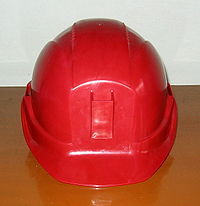
Miner's helmet
![]()
A Miner's helmet is a type of helmet worn for safety purposes by miners while in the process of mining.![]()
From http://en.wikipedia.org/
Labels: Mining
Posted by my blog at 4:06 AM 0 comments
Tuesday, March 30, 2010
Mine Caps
Mine Caps are typically used to prevent access to old, abandoned mines. People, especially the young, like to explore their surroundings but may not fully understand the dangers inherent within, and surrounding, a mine.
Why Do Mines Need To Be Capped?
Cave-ins, poor air quality, wet slippery surfaces, etc. are real dangers when entering a mine, but even the surrounding area can be dangerous. Older mines may have been covered with logs or wooden beams with loose rock and soil over the top. These fail over time, creating sinkholes, that may not be visible on the surface, until enough weight collapses it.
Law Requirements
Federal and State laws dictate certain aspects in the capping process, such as allowances for bats to have access. The type of mine, water table, geology, etc. are all considered when choosing which type of cap will be used for a given mine entrance.
Concrete Caps
Concrete continues to be the preferred method for capping vertical shafts. Considerations can be made in the design to allow for an entrance to the mine, a steel door for humans, a slot for bats, a hole for airflow. The slabs thickness can vary from as little as 6 inches to several feet.
Expanding Foam
Expanding foam is quickly replacing concrete for some vertical shafts, typically mines where an entrance for humans is no longer desired. This type of cap is sometimes referred to as a "Plug." Plugs usually have a taper to them, smaller on the bottom and wider on the top, like the cork on a wine bottle. Expanding foam plugs need to be quite thick, usually no less than 6 feet deep. Typically, loose rock and soil is placed over the top.
Steel Plates
1/4 inch or thicker steel-plating is also used, on both horizontal and vertical shafts. These allow for easier customization than concrete, cutting access holes in steel is far easier than building the concrete forms necessary for the same result. This type of cap is used where easy access is a necessity.
From http://en.wikipedia.org/
Labels: Mining
Posted by my blog at 8:11 AM 0 comments
Monday, March 22, 2010
Magnetation (iron ore)
Magnetation is a term referring to the processing of iron ore tailings, the waste product of iron ore mines, to recover hematite. Crushed mine tailings are mixed with water to create a slurry; the slurry is then pumped through magnetic separation chambers to extract hematite. Commercial interest in this process stems from the possibility of extracting additional iron from tailings supplied by existing mines, increasing their yield.
From http://en.wikipedia.org/
Labels: Mining
Posted by my blog at 6:31 PM 0 comments
Tuesday, March 16, 2010
Fly-in fly-out
Fly-in fly-out is a method of employing people in remote areas.
Overview
Rather than relocating the employee and their family to a town near the work site, the employee is flown to the work site where they work for a number of days and are then flown back to their home town for a number of days of rest.
Fly-in fly-out is very commonly used in the mining industry, as mines are often in areas far from towns.
Usually a fly-in fly-out job involves working a long shift (e.g. 12 hours each day) for a number of continuous days with all days off spent at home rather than at the work site. As the employee's work days are almost entirely taken up by working, sleeping and eating, there is little need for any recreation facilities at the work site. However, companies are increasingly offering facilities such as pools, tennis courts and gyms as a way of attracting and retaining skilled staff.
Generally fly-in fly-out work sites use portable buildings as typically there is no long-term commitment to the work site (e.g. the mine will close once the minerals have been extracted).
Employees like fly-in fly-out arrangements as their families are often reluctant to relocate to small towns in remote areas, due to the lack of opportunities for partner's employment, limited educational choices for children and poor recreational facilities.
Employers prefer fly-in fly-out arrangements when the cost of establishing facilities of sufficient quality to attract families to live locally will exceed the cost of creating basic facilities for a fly-in fly-out community plus the cost of airfares.
Negative effects
On the negative side, fly-in fly-out employment can put stress on family relationships and may stifle regional development.
Mining towns that once had a considerable size, like Wiluna in Western Australia, which had a population of 9,000 in 1938, have shrunk to a population of 300, with almost all employees of the local mines on fly-in fly-out rosters.
From http://en.wikipedia.org/
Labels: Mining
Posted by my blog at 11:03 PM 0 comments
Saturday, March 13, 2010
Face (mining)
In mining, the face is the surface where the mining work is advancing. In surface mining it is commonly called pit face, in underground mining a common term is mine face.
Accordingly, face equipment is the mining equipment used immediately at the mine face used for removal and near-face transportation of the material: cutting machines, loaders, etc.
From http://en.wikipedia.org/
Labels: Mining
Posted by my blog at 9:21 AM 0 comments
Monday, March 8, 2010
Exploration diamond drilling
![]()
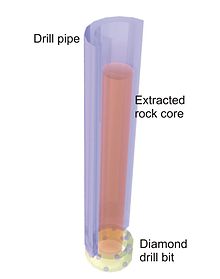
Exploration diamond drilling is used in the mining industry to probe the contents of known ore deposits and potential sites. By withdrawing a small diameter core of rock from the orebody, geologists can analyze the core by chemical assay and conduct petrologic and mineralogic studies of the rock.![]()
History![]()
Early diamond drilling opened up many new areas for mineral mining, and was related to a boom in mineral exploration in remote locations. Before the invention of the portable diamond drill, most mineral prospecting was limited to finding outcrops at the surface and hand digging.
Diamond drilling![]()
Exploration diamond drilling differs from other geological drilling (see Drilling rig) in that a solid core is extracted from depth, for examination on the surface. The key technology of the diamond drill is the actual diamond bit itself. It is composed of industrial diamonds set into a soft metallic matrix. As shown in the figure, the diamonds are scattered throughout the matrix, and the action relies on the matrix to slowly wear during the drilling, so as to expose more diamonds. The bit is mounted onto a drill stem, which is connected to a rotary drill. Water is injected into the drill pipe, so as to wash out the rock cuttings produced by the bit. An actual diamond bit is a complex affair, usually designed for a specific rock type, with many channels for washing.
The drill uses a diamond encrusted drill bit (pictured on the right) to drill through the rock. The drill produces a "core" which is photographed and split longitudinally. Half of the split core is assayed while the other half is permanently stored for future use and reassaying if necessary. Although a larger diameter core is the most preferred it is the most expensive. The most common diameter sizes of core are NQ and CHD 76.
Core extraction
Merely advancing the drill by rotary action (and washing) causes a core to be extracted inside the barrel as shown. However, at a depth of perhaps 300 m, there must be a way to retrieve the core and take it to the surface. Constantly withdrawing the entire heavy drill pipe is impractical, so methods were developed to pull up the core inside the barrel. If the rock would always be solid granite, and the core would always break at the drill bit, then it would be a simple matter to stop the drilling, and lower a simple grabbing device by a wire and pull up the core. Unfortunately, many applications require an undisturbed core in fractured rock, which calls for elaborate wire-line devices.
The photo shows the extraction of a core, using a triple-tube wire-line system, capable of extracting core under the worst conditions. This is very important when exploring fault zones such as the San Andreas Fault.
Tube sizes
There are five major "wire line" tube sizes typically used. Larger tubes produced larger diameter rock cores and require more drill power to drive them. The choice of tube size is a trade-off between the rock core diameter desired and the depth that can be drilled with a particular drilling rig motor.
From http://en.wikipedia.org/
Labels: Mining
Posted by my blog at 7:39 AM 0 comments
Saturday, February 27, 2010
Core sample
![]()
A core sample is a cylindrical section of a naturally occurring medium consistent enough to hold a layered structure. Most cores are obtained by drilling into the medium, for example sediment or rock, with a hollow steel tube called a corer. The hole made for the core sample is called a core hole. A variety of corers exist to sample different media under different conditions. More continue to be invented. In the coring process the sample is pushed more or less intact into the tube. Removed from the tube in the laboratory, it is inspected and analyzed by different techniques and equipment depending on the type of data desired. Analysis is generally non-destructive of most of the sample.
Methods
* gravity coring, in which the core sampler is dropped into the sample
* drilling exploration diamond drilling
* vibracoring, in which the sampler is vibrated to allow penetration into thixotropic media.
Management of cores and data
Coring is the method to retrieve cores samples from the ground. Coring is often utilised in ocean drilling and surveying. Scientist often using coring to acquire core samples for study.
Drilling equipment is often used for coring. Rock core is often taken during mineral exploration operations to help determine the rock type and amount of mineralisation present. A diamond impregnated core bit is used which is rotated to cut an annulus of rock, producing a rock core which extends through the bit into the core barrel. In a wireline system, the core barrel can be retrieved using a wire cable that is run inside the drill rods. Thus, the drill rods do not have to be removed from the borehole each time a core run is complete. Diamond coring can be carried out to depth of 2000m using conventional mineral exploration drilling equipment. Core can be recovered from deeper wells but the operation becomes more expensive.
The technique of coring long predates attempts to drill into the Earth’s mantle by the Deep Sea Drilling Program. The value to oceanic and other geologic history of obtaining cores over a wide area of sea floors soon became apparent. Core sampling by many scientific and exploratory organizations expanded rapidly. To date hundreds of thousands of core samples have been collected from floors of all the planet’s oceans and many of its inland waters.
Access to many of these samples is facilitated by the Index to Marine & Lacustrine Geological Samples,
"A collaboration between twenty institutions and agencies that operate geological repositories."
The above agency keeps a record of the samples held in the repositories of its member organizations. Data includes
"Lithography, texture, age, principal investigator, province, weathering/metamorphism, glass remarks and descriptive comments"
Layering
Any natural medium at or under the Earth’s surface or other body that is consistent enough to maintain a solid or semi-solid structure is layered. The layering comes from successive deposition or growth in time of structural or compositional variants of the medium.
Most familiar to us are the stratigraphic layers of the Earth’s surface on which the geologic history of the surface is based; for example, the Eocene, Oligocene, Miocene, etc. Each layer in this case contains distinctive fossils generated by the evolution of species. Layers often are divided into sublayers.
Layering is more pervasive than the broad outline of the Geologic Time Scale leads us to believe. Any change in environment causes a new layer to be deposited. A succession of plant species in a region, for example, causes a succession of layers containing different pollen in ice and mud. Variation in rainfall causes tree rings to be of different widths.
Informational value of core samples
Scientific coring began as a method of sampling the ocean floor. It soon expanded to lakes, ice, mud, soil and wood. Cores on very old trees give information about their growth rings without destroying the tree.
Cores indicate variations of climate, species and sedimentary composition during geologic history. The dynamic phenomena of the Earth’s surface are for the most part cyclical in a number of ways, especially temperature and rainfall.
There are many ways to date a core. Once dated, it gives valuable information about changes of climate and terrain. For example, cores in the ocean floor, soil and ice have altered the view of the geologic history of the Pleistocene entirely.
From http://en.wikipedia.org/
Labels: Mining
Posted by my blog at 4:01 PM 0 comments
Monday, February 22, 2010
Chat (mining)
Chat is a term for fragments of siliceous rock, limestone, and dolomite waste rejected in the lead-zinc milling operations that accompanied lead-zinc mining in the first half of the twentieth century. Historic lead and zinc mining in the Midwestern United States was centered in two major areas: the Tri-State area covering more than 2,500 square miles (6,500 km2) in southwestern Missouri, southeastern Kansas, and northeastern Oklahoma and the Old Lead Belt covering about 110 square miles (280 km2) in southeastern Missouri. The first recorded mining occurred in the Old Lead Belt in about 1742. The production increased significantly in both the Tri-state area and the Old Lead Belt during the mid-1800s and lasted up to 1970.
Cleanup
Currently production still occurs in a third area, the Viburnum Trend, in southeastern Missouri. Mining and milling of ore produced more than 500 million tons of wastes in the Tri-State area and about 250 million tons of wastes in the Old Lead Belt. More than 75 percent of this waste has been removed, with some portion of it used over the years. Today, approximately 100 million tons of chat remain in the Tri-State area. The EPA, the states of Oklahoma, Kansas and Missouri, local communities, and private companies continue to work together in implementing and monitoring response actions that reduce or remove potential adverse impacts posed by remaining mine wastes contaminated with lead, zinc, cadmium, and other metals.
Ore processing
Ore production consisted of crushing and grinding the rock to standard sizes and separating the ore. Ore processing was accomplished in either a dry gravity separation or through a wet washing or flotation separation. Dry processes produced a fine gravel waste commonly called “chat.” The wet processes resulted in the creation of tailing ponds used to dispose of waste material after ore separation. The wastes from wet separation are typically sand and silt size and are called “tailings.” Milling produces large chat waste piles and flat areas with tailings deposited in impoundments. Tailings generally contain higher concentrations of heavy metals and therefore present a higher risk to human health and the environment through direct contact. Chat typically ranges in diameter from 1/4 to 5/8 inch. Intermingled material such as sands measure 0.033-0.008 inches in diameter and fine tailings are less than 0.008 inches (0.20 mm) in diameter.
Uses for chat
Chat piles appear grayish white in color and impact surrounding environments severely. Chat can be used to sprinkle on snow-covered roads to improve traction, as gravel, concrete aggregate, and asphalt pavement. These chats, found as huge man-made mounds in that county, are utilized as construction aggregate, principally for railroad ballast, highway construction, and concrete production.
From http://en.wikipedia.org/
Labels: Mining
Posted by my blog at 8:57 PM 0 comments
Monday, February 8, 2010
Cave-in
![]()
A cave-in is a collapse of a geologic formation, mine or structure which typically occurs during mining or tunneling. Geologic structures prone to cave-ins include alvar, tsingy and other limestone formations, but can also include lava tubes and a variety of other subsurface rock formations.
In mining, the term roof fall is used to refer to a range of collapses, ranging from the fall of a single flake of shale to collapses that form sink holes that reach to the surface. Note that roof falls in mining are not all accidental. In longwall mining and retreat mining, miners systematically remove all support from under large areas of the mine roof, allowing it to settle just beyond the work area. The goal in such mining methods is not to prevent roof fall and the ensuing surface subsidence, but to control it.
From http://en.wikipedia.org/
Labels: Mining
Posted by my blog at 8:32 AM 0 comments
Thursday, February 4, 2010
Alicanto
The Alicanto or Allicanto is a mythological bird of the desert of Atacama, pertaining to Chilean mythology.
Legend
The legend says that the alicanto's wings shine during the night with beautiful, metallic colors, and their eyes emit strange lights; making a luminous flight some would not project shade on the desert.
This bird brings luck to any miner who sees it. Alicanto live in small caves between hills containing minerals, and feed on gold and silver.
If the lucky miner follows an alicanto without being caught, they can find silver or gold. But, if the alicanto discovers them, the bird will guide the greedy miner off a cliff, causing them to fall to their death.
Alicanto should not be confused with the Alicante, a fictional Mexican snake that drinks mother's milk and impregnates women, or uses the human stomach as a living place.
From http://en.wikipedia.org/
Labels: Mining
Posted by my blog at 12:08 PM 0 comments
Sunday, May 17, 2009
Miner
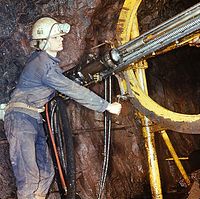
A miner is a person whose work or business it is to extract ore or minerals from the earth. It is considered one of the most dangerous trades in the world. In some countries miners often do not have social guarantees and in case of destruction or mutilations they are left to the mercy of fate.![]()
Banning for women and children
In 21 June 1935 the Convention No. 45 was adopted by the International Labour Organization, where the Article II establishes prohibition of women work in underground mines: "No female, whatever her age, shall be employed on underground work in any mine."
This text has been ratified by 70 countries, 28 of which have denounced
From http://en.wikipedia.org/

Labels: Mining
Posted by my blog at 4:12 AM 0 comments